

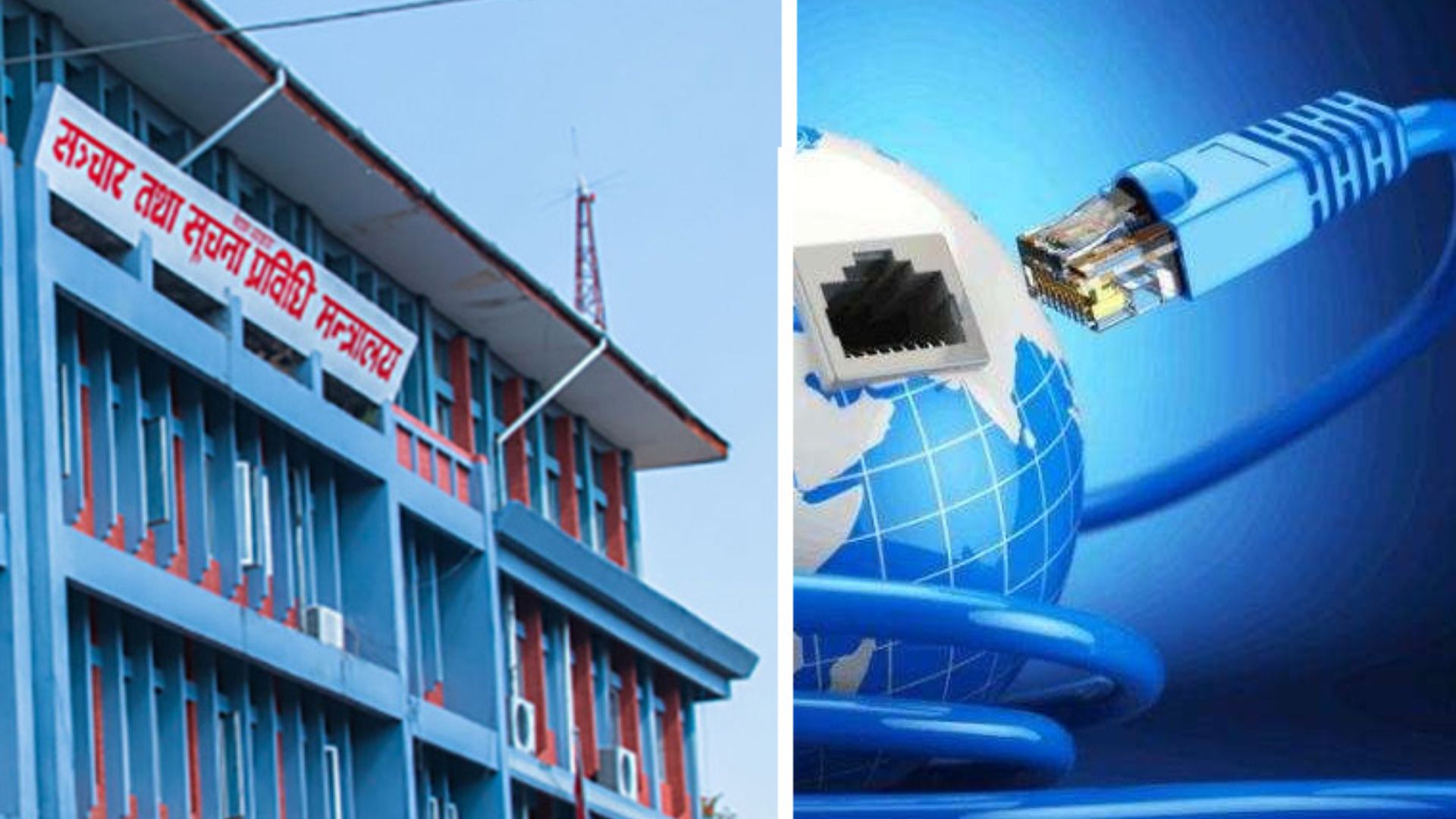
How the Internet of Nepal is collapsing due to the lahad of the Ministry The Internet service of Nepal has reached a complicated mode after the government stopped recommending the currency to be paid by the service provider to the Indian upstream provider for the international bandwidth that connects Nepal with the Internet world.
It has been more than eight months since the government stopped recommending foreign currency in this way. Upstream provider companies including Tata, Airtel, and Siffi have sent letters to the Internet providers of Nepal with a warning that they will stop the service from the 15th of Poush due to non-payment for a long time.
In defiance of the Supreme Court and the Public Accounts Committee, the Ministry of Communications and Information Technology has now withheld the amount of money to be paid to the foreign service provider for non-payment of royalties and Rural Telecommunication Development Fund (RTDF) dues for maintenance fees.
However, because of public criticism, the service provider was not ready to allow the increase in the customer fee in line with the increased telecommunication service fee. However, in the name of price adjustment, an agreement was reached between the two parties to ‘split’ the billing and not to charge telecommunication service charges for up to 50 percent of maintenance charges.
The Public Accounts Committee of the Federal Parliament has been reminding the government that maintenance is a non-telecommunication service and has been repeatedly instructing the government to clarify the unclear law. Similarly, the Supreme Court has also issued an interim order not to collect royalties because the maintenance charges are included in non-telecommunications services.
The regulator Nepal Telecommunication Authority is not in favor of stopping the foreign currency recommendation as the service itself will be disrupted due to the issue of disputed arrears. Accordingly, the authority has been sending recommendations to the ministry regarding the foreign exchange rate.
It is said that a total of 2 billion 47 crores 35 lakhs 59 thousand 978 rupees should be charged from different nine internet service providers. In that letter, it is alleged that incomes such as maintenance, support charges, and technical charges have been split and bundled in a manner that does not fit in the income statement to reduce the royalty revenue liability to be paid. In that context, it is mentioned that even the authorities did not monitor such activities.
Internet service provider company Worldlink Communications Limited replied to it through a letter dated 19 October 2080 and informed that it has paid the entire amount of royalty and rural telecommunication development fund in the year 2078/079. In 2078/79, the company has a total income of 9 billion 39 million 25 million 32 thousand rupees, out of which, 4 billion 97 million 57 million 95 thousand rupees are from telecommunication services and 4 billion 41 million 67 million 37 thousand rupees from non-telecommunications.
Controversy over 13 percent telecom service charge
Effective from Shrawan 1, 2075, the then KP Sharma Oli-led government announced a 13 percent telecommunication service fee on internet services at once. The policy that came through the budget statement for the financial year 2075/076 was criticized a lot.
To promote the use of information technology, the government imposed an additional 13 percent tax on the areas that were suffering from high taxes, while making internet services accessible to everyone. While before that the rate of such tax was 11 percent on the telephone, it was zero on the internet.
To implement the ministerial decision, the Ministry of Finance, on the recommendation of the Ministry of Communications, submitted a proposal to the Council of Ministers to amend the Telecommunication Regulations. Based on the same proposal, the cabinet meeting on 23rd June 2076 decided to give a discount on the telecommunication service fee for 2075/76 along with the amendment of the regulations.
Internet providers were cheated in the name of price adjustment
When the government was implementing a 13 percent telecommunication service fee, the average price of the cheapest package of fixed internet service providers in the market was around Rs 1,200. If we look at the general calculation within that, if the service provider’s internet cost is Rs 1002, royalty is Rs 40, RTDF is Rs 20 and VAT is Rs 138. When the 13 percent telecom service charge is implemented, the price paid by the customer would have increased to Rs 1,347.
On top of that, a 30 percent income tax has also been levied on profits from Internet businesses like the liquor industry. Service providers say that Nepal’s Internet market, which has recently become unstable due to unhealthy competition, is facing more difficulties due to the extortion of the Ministry of Communication and Information Technology.
In some cases, the officials of the Ministry of Communication are heard making irresponsible statements that even if some Internet service provider companies are closed, others will come.
What is in the interpretation of the court and parliamentary committee?
Telecommunication service charges are charged only for telecommunication services. Therefore, during the price adjustment, the government has arranged that up to 50% of the telecommunications service fee can be billed in the name of maintenance.
Rural telecommunication development fund and royalty, which are only for telecommunication services, cannot be applied to the title of not charging telecommunication service fees.
From the above discussion on the 56th report of the Auditor General, on 30th June 2076, the Public Accounts Committee of the House of Representatives instructed the government to remove the unnecessary charges by saying that RTDF and royalty should not be levied on non-telecommunications services such as support charge, annual maintenance, technical charge, and monitoring charge.
In addition to that, during the discussion on the 58th report of the Accounts General, in the committee meeting on 28 June 2079, it was seen that according to Rule 26 and Schedule 6 (a) of the Telecommunication Regulations, RTDF and royalty will not be levied on non-telecommunication services such as support charge, annual maintenance, technical charge and monitoring charge. By saying this, the committee again instructed to remove the beruju lagat.
In that case, the joint bench of the then Chief Justice Cholendra Shamsher Jabara and Tej Bahadur KC gave an interim order saying that the maintenance charge would fall under non-telecommunication services and therefore not to collect royalties. “This order has been extended till the end of the writ petition,” said the Supreme Court.
The hearing date has been set for the next 21 Falgun 2080 for the case currently under consideration in the Supreme Court. In this way, the Ministry of Communication is disobeying even the court, which is the last body to interpret the law.
All these internet services have to be done but people don’t even know about these things. Internet services are also done by everyone working together. But you have to pay a fee for charging the country. This new name has also been applied here.
It is good that the government of Nepal implemented this service. However, when it comes into effect, everyone should take a good look. Please see this post carefully