

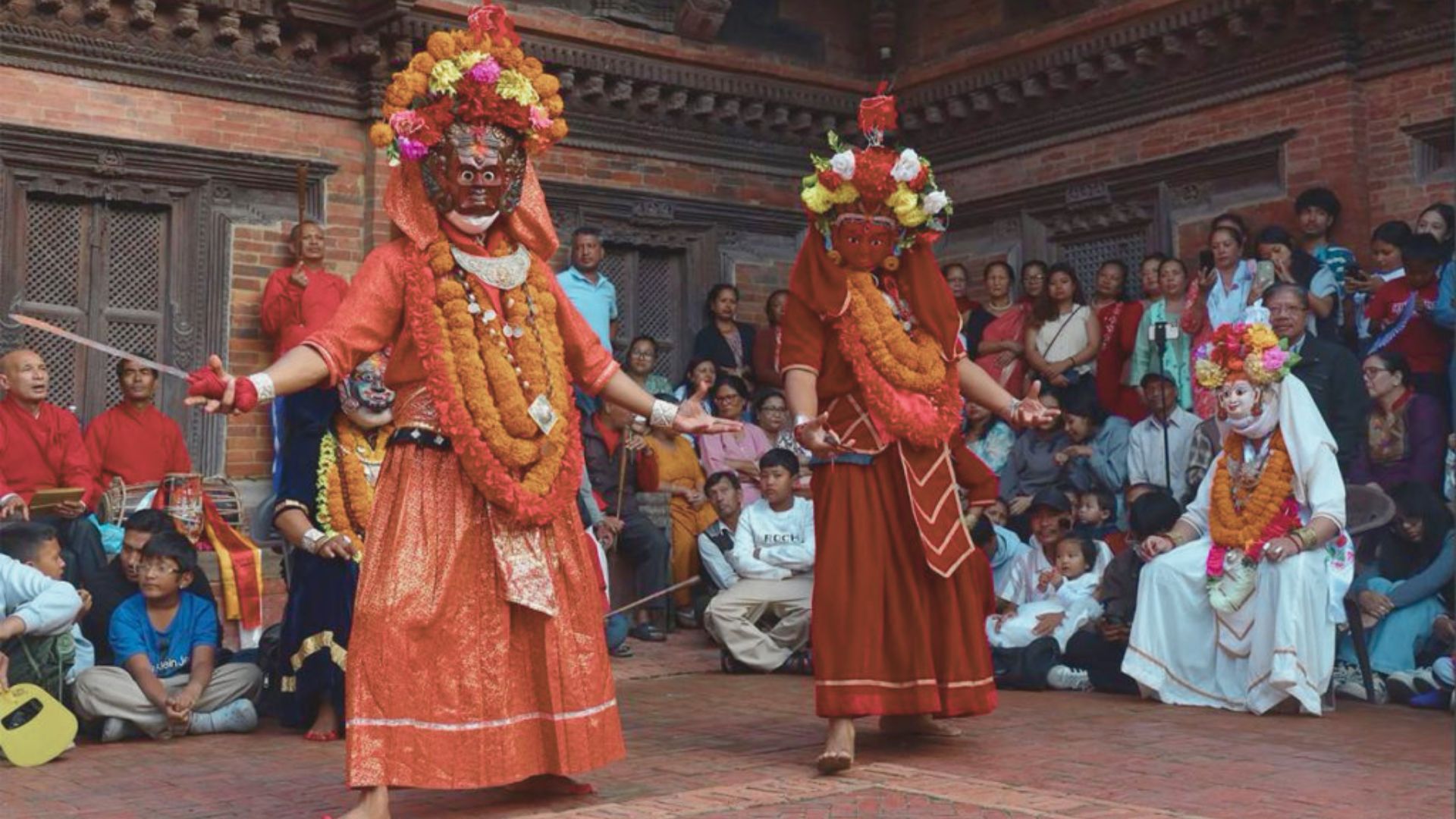
Patan’s Malla-Era Ashtamatrika Dance Complete The ‘Ashtamatrika Nach’ (known locally as ‘Ga: Pyakhan’)—a performance of religious, historical, and cultural significance in Patan, Lalitpur—has concluded, having been observed in accordance with traditional Tantric rituals and religious faith.
Rajendra Shakya, Chairperson of the Ashtamatrika Nach Management Committee, stated that this festival—which begins annually on the day of Ghatasthapana and spans 11 days—was performed this year as well, following traditional customs and deep religious devotion.
This tantric dance, which was introduced during the reign of the Malla-era King Srinivasa Malla (Nepal Sambat 784), is considered to be approximately 362 years old.
According to Shakya, the chairperson of the Dance Management Committee, this dance—performed by artists from the Shakya and Bajracharya lineages of the Newar community—dates back to the reign of the Malla-era King Srinivasa Malla (Nepal Sambat 784). It was initiated with the belief that it would ensure peace, security, and prosperity in the land, and provide liberation from the eight great perils of human life (water, fire, lions, snakes, elephants, thieves, imprisonment, and supernatural spirits).
The dance commenced at Nakbahil, was performed at the Mulchowk of the Patan Durbar Square, and concluded after being staged once again at Nakbahil—a process that spanned the first four days.
Following performances held at the Kartik Dabali over five nights, and daytime presentations at the Mulchowk on the days of Phulpati and Vijaya Dashami, this year’s Ashtamatrika dance concluded today—the final day, Ekadashi—with a special performance at the Nakbahil Dabali.
Thirteen deities of Singhrini (white color), Bhairava (blue colour), Ganesha (white color), Kumar (blood color), Bramhayani (kokum color), Maheshwari (white colour), Kaumari (blood color), Vaishnavi (green colour), Barahi (blood colour), Indrayani (kukum color), Chamunda (blood color), Mahalakshmi (blood colour), Vyaghrini (yellow colour) participate in this dance.
Following the purification of their diet and lifestyle, and the performance of Tantric rituals on the eve of Ghatasthapana, the performers—attired in their traditional costumes and ornaments, but without wearing their masks—assemble in the courtyard of the Nityanath Temple at Nyakhachuk. From there, they proceed in an orderly procession through Nagbahal to Nakbahil. The dance commences on the evening of that same day.