

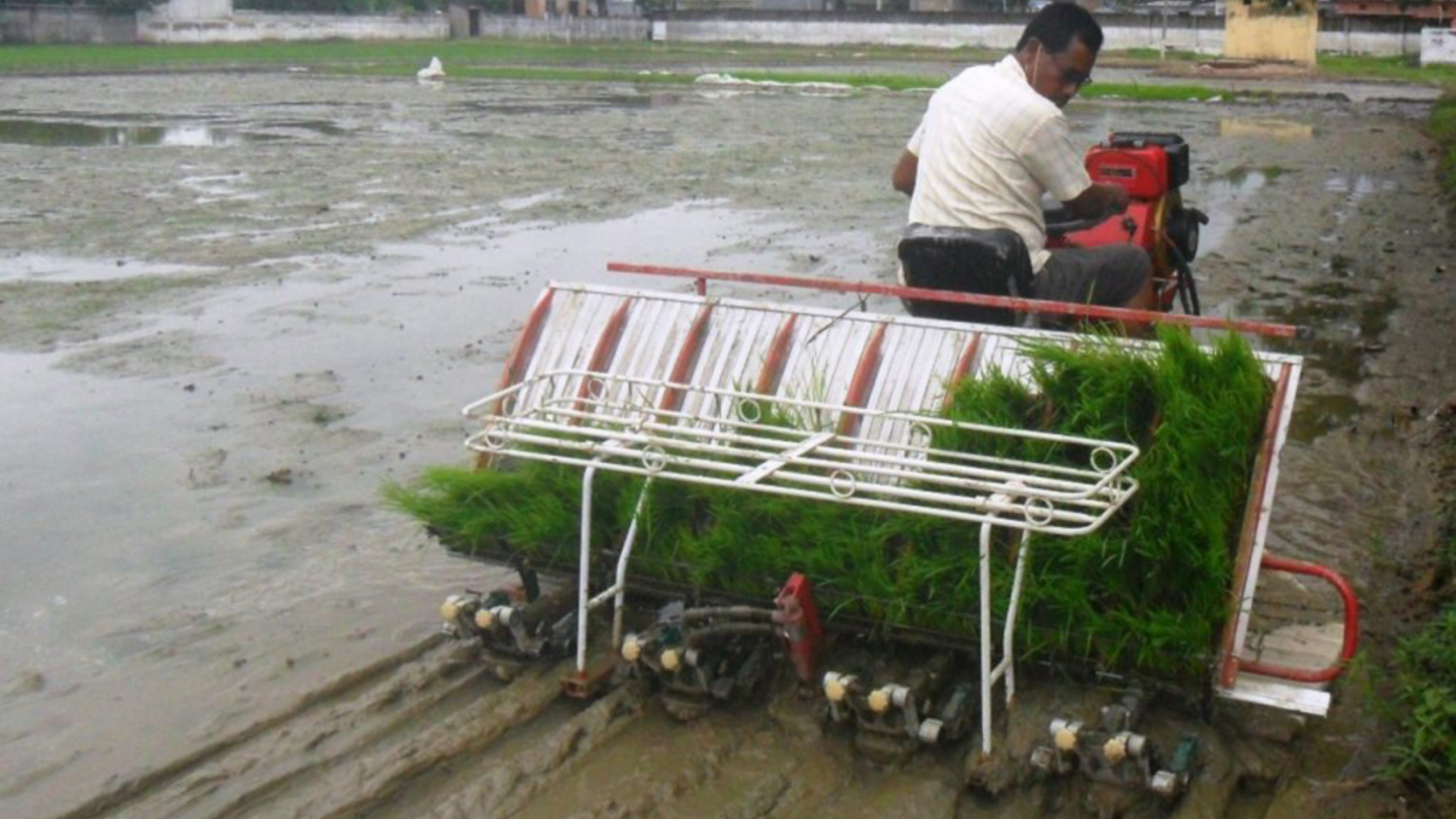
Decreasing Paddy Cultivation Area and Increasing Production with Technology On the occasion of National Rice Day, the government is organizing a grand program on Saturday. The 21st National Paddy Day and Planting Festival is being held for the first time in Chitwan outside the Kathmandu Valley.
The Ministry of Agriculture is going to celebrate Paddy Day by planting one and a half bigha in Chitwan Bachahuli.
Recently, the area under cultivation for rice production in Nepal has started to decrease. In the current financial year 2080/81, the total area under paddy crop has decreased by 0.61 percent, i.e., 8,800 hectares, compared to the previous year, according to the Department of Agriculture.
Although the area of paddy cultivation has decreased, the production has increased somewhat, the department said. The current year’s total paddy production has increased by 4.33 percent over last year’s 2079/80.
Current-season rice production has reached 57 lakh 24 thousand 234 tons, which is 5.08 percent more than the average production of four years.
Similarly, the average productivity of paddy has increased by 4.97 percent compared to last year and reached 3.98 tons per hectare, which is 6.92 percent more than the average productivity of four years.
How did the production increase when the area decreased?
According to the Ministry of Agriculture, the increase in rice production in the current season is due to improved seed availability and use and a reduction in disease and insect outbreaks.
Similarly, the ministry mentioned the reduction in the negative impact of floods and landslides on the rice crop this season and the improvement in fertilizer availability as the reasons for the increase in production.
Chaite rice production and area both decreased
As the total rice production increased compared to last year, the area and productivity of Chaite rice production and cultivation decreased. Last year’s production of 540 thousand 331 tons of rice has been limited to 520 thousand 808 tons in the current year.
In this way, Chaite rice production in the current year is 3.61 percent negative compared to the last year. Similarly, the area under Chaite paddy cultivation has also decreased by 3.59 percent compared to last year.
Billions worth of paddy-rice imports
Nepal has imported paddy and rice worth $20 billion in the 11 months of the current year.
According to the Ministry of Agriculture, till the end of May 2080/81, it had imported 30 million, 53 million, 10 thousand, and 520 kg of rice worth 11 billion, 55 million, 25 million, and 79 thousand rupees.
Similarly, 8 billion, 69 million, 685 thousand, 8 billion, 27 million, 69 thousand, and 89 kg of rice have been imported.
How long have you planted?
By the second week of June, only 9.8 percent of the total area to be planted in the country had been planted.
As of Ashar 12, paddy has been planted in only 136,411 hectares of the total planting area across the country. Planting is done on 13 lakh, 98 thousand, and 836 hectares in Nepal.
According to the Department of Agriculture, the planting rate has not increased this year as compared to last year. Till Ashar 10, 2080, 8.75 percent of the total planting area was planted.