

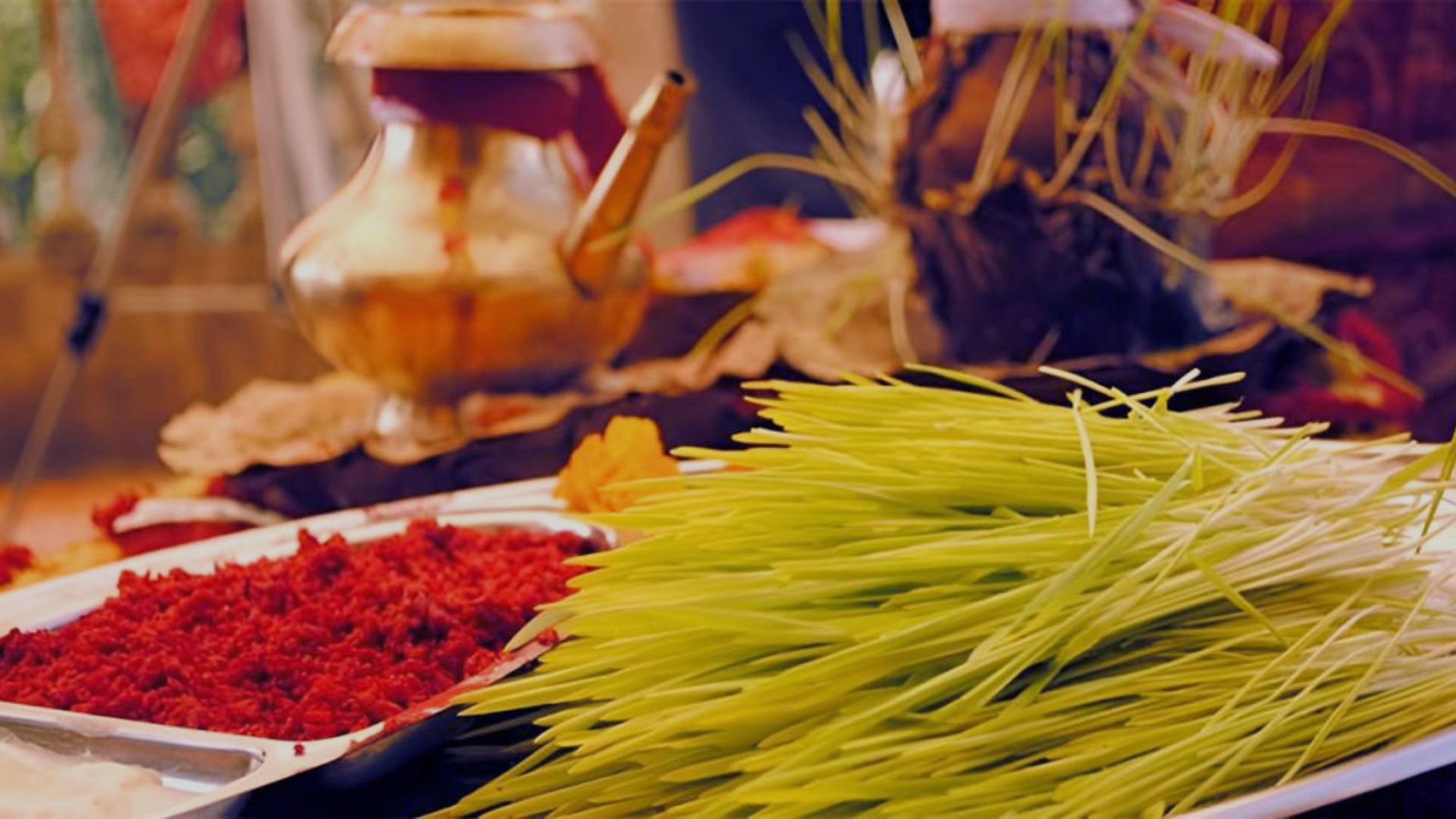
Which Direction Should One Face When Receiving A Tika? What Should Be Done Before Receiving A Tika? Today, on the main day of Bada Dashain—also known as Durga Paksha—people are receiving the “tika” (a red mark) and “jamara” (sprouted barley shoots) from their elders. The “tika” is considered a “prasad” of the Navadurga (the nine forms of Goddess Durga) and a symbol of an auspicious moment, while the “jamara” serves as a symbol of prosperity.
According to the Nepal Calendar Determination Development Committee, the “tika” can be applied following the “Devi Visarjan” (the ritual conclusion of the Goddess’s invocation) at 8:49 AM today. However, for those seeking the most auspicious time (uttam sahit), the Committee has designated 10:26 AM.
Since facing south is reserved exclusively for rituals dedicated to one’s ancestors, it is not customary to face south when receiving or applying “tika” during Dashain. Some people determine the direction for applying or receiving “tika” based on the position of the moon and specific auspicious timings (saiit); however, such a detailed approach is not the general practice.
The Nepal Calendar Determination Development Committee has stated that the person receiving the *tika* should face west, while the person applying it should face east.
The Significance of Water Kept in the *Kalash*
Following the “Durga Visarjan” (the ritual conclusion of the Durga worship), the tradition of applying “tika” begins. Initially, “tika” is offered to the family deities (Kuldevata) and ancestral spirits (Pitridevata). In some places, there is a custom of applying “tika” above the main entrance of the house. Subsequently, “tika” is received from respected elders.
According to religious belief, the water contained within the “Kalash” (ceremonial vessel) becomes extremely sacred after the “Durga Visarjan”. This water is used for “abhishek” (consecration/sprinkling), and the “jamara” (sprouted barley shoots) are harvested while invoking one’s chosen deity (Ishtadevata) and family deities (Kuldevata). Thereafter, “tika” is applied above the threshold of the doorway.
For those who wish to determine the most auspicious moment (saiit) to receive “tika”, the ideal time has been set for 10:26 AM. In cases where someone is in a hurry or compelled to travel a long distance, there is a tradition of receiving “tika” at sunrise. Furthermore, it has long been customary to receive “tika” at any time on the day of Dashain.
Once the sun has risen and one has received “tika” from elders according to the prescribed rituals, one may travel elsewhere to receive “tika” from other elders who may be farther away. “Therefore, there is no need to harbour any confusion regarding the auspicious time for ‘ tika ‘,” says Prof. Dr Devmani Bhattarai, a former member of the Nepal Calendar Determination Development Committee.
Some people might even find themselves in a situation where they can only arrive in Nepal late—perhaps even on the day of Dashain itself. In such cases, there is no need to feel conflicted just because the auspicious time (sai) has passed. It is perfectly appropriate to receive “tika” and “prasad” from elders, regardless of when you arrive.