

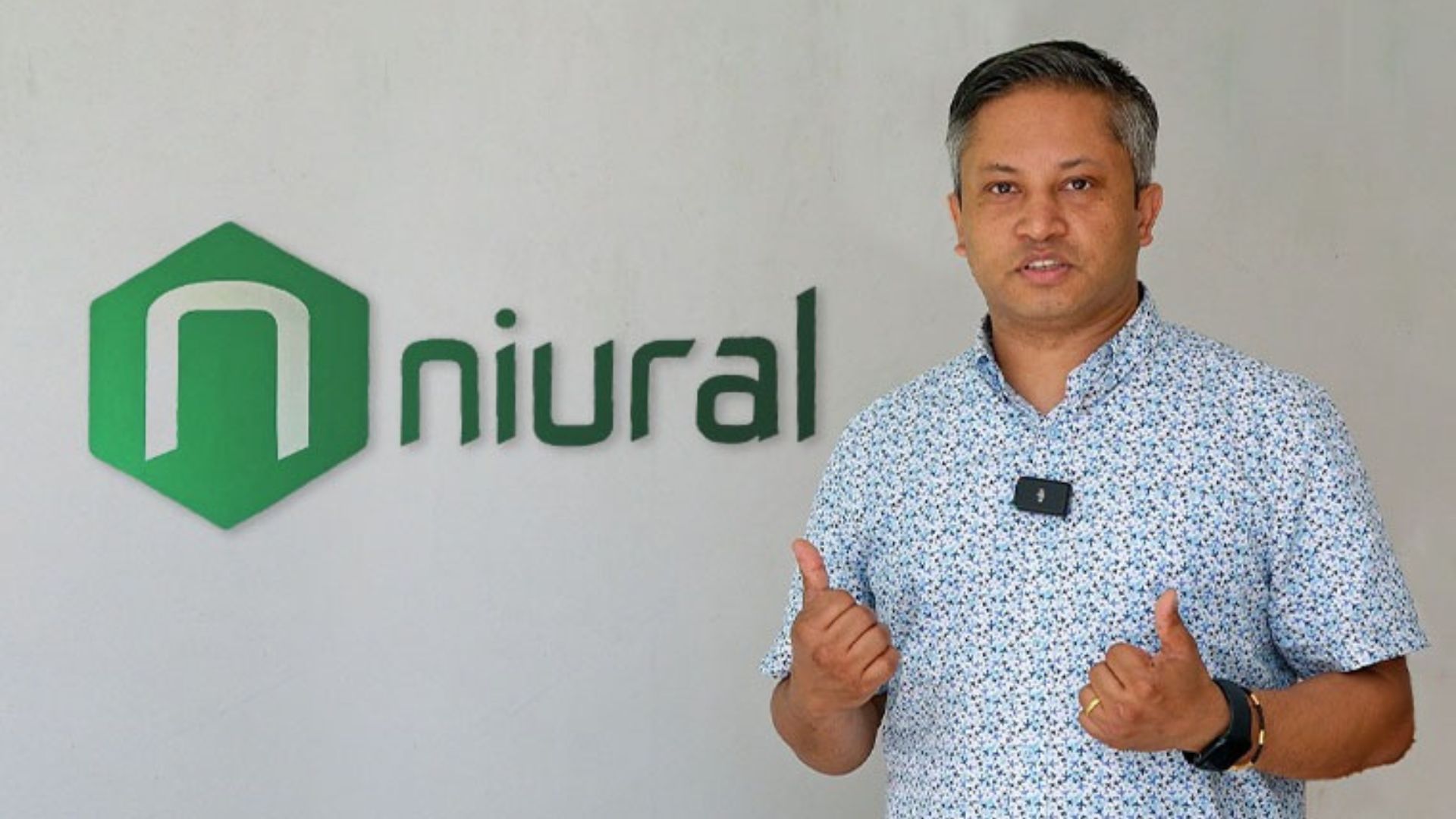
A Nepali Startup Automating The Payroll Of US, Canada And UK Companies Neural is a company started with the aim of solving the current problems of payment systems in the world. It is a global tech company based in Nepal. Its co-founder and chairman is Naveen Baskota.
Currently, Neural’s service area is focused on America, Canada, and the UK. Being a company based on payroll payment, these countries are not included in its service sector.
The process of paying any company to its employees can be understood as payroll. In other words, payroll is the salary that the company gives to its employees and their details.
According to the co-founder and president Baskota, Neural helps companies in the US and other countries with payroll, bill payments, employee appointments, appointment letters, tax payments, etc. All that work is done automatically in Neural’s system.
Neural has started providing this type of service after various companies started hiring manpower from all over the world after the COVID-19 epidemic. Co-founder Baskota says that this will also benefit the related companies. He claims that the work of hiring international employees will be completed within 24 hours through Neural’s system.
He says that it used to take six/seven months to do this work. Neural makes it easy for client companies to hire employees from outside their country. As a result, employees are also able to stay in their own country and work internationally.
Co-founder Baskota said that it was the team here that developed Neural’s system. On the other hand, Neural has leadership, sales, and marketing teams in America. Where about 17/18 people are employed.
He says that the team Nepal will increase by two/to three times by next year i.e. by 2025. He said that there is a plan to add manpower to the Nepalese team not only to make products but also to look after customer service, account management, sales, etc., so the team will grow.
In the same way, he says that there are problems from setting up offices to internet in Nepal. Moreover, the time zone of Nepal does not match with the countries he is serving.
However, he stayed in Nepal and used local manpower to create a world-class product and company. According to him, there are world-class engineers in Nepal. An example of this is the fact that more than 60,000 IT personnel are working for foreign companies in Nepal. However, they have not got enough exposure. Baskota says the same.
Similarly, he said that most of the IT companies working for foreign companies in Nepal do outsourcing and project-based work. But Neural makes products that are directly used by companies.
“If you send money to someone in America, you will not receive it immediately. A third party is also involved in that. There are such small problems. The solution of which can be neutral,” he says.
Being a company based in Nepal, it is natural to think that Neural provides services here. But so far the company has not extended its services to the Nepali market. He says that Neural’s services are not available in Nepal because the economic system has not matured in terms of technology.
Today, the banking and financial sector is gradually becoming digitalized in Nepal. But still business to business is lagging behind. He said that he would provide his services for Nepal if the economic system started to mature.
Now the product Neural is ready and has gone to the market. During this period, due to various tests, the product has also been refined. That’s why now they are paying attention to the development and expansion of the company, says Baskota.
He said that because Nepali companies have a ‘competitive advantage’, he is also taking advantage of it. “We have a ‘competitive advantage’ to compete with American companies. Because labor is expensive in America. Even though the Nepali workforce is paid a good amount, it is less compared to the US,” he says.
Lately, startup companies have been increasing in Nepal. Neural is also a startup. There is also a tendency to open an office in Nepal only after starting a company abroad. Baskota himself has done the same. He has experience that by doing this, it will be easier to raise investment in the company.
He says that as much as it is difficult for a company started in Nepal to raise investment, compared to that, it is easier for those starting a company abroad. He believes that the reason for this is that foreign investors have more faith in companies that have been started abroad.
The government of Nepal has recently started a process to support similar startups by giving loans of up to 25 lakh rupees. But he insists that the government should give grants instead of giving loans.
“The government should have thought that entrepreneurs would give so much if they did such and such work in this and that sector. I should have become their advisor,” he says, “giving loans, but I am not sure what to do after that. Without that, the plan will not be successful. Because startups are confused about where to market, and where to prepare their products.
For this, founders should mainly expand relationships, be clear about the problem to be solved by the startup idea, be sure that their product will earn money, and have confidence, he says. But in Nepal, the idea is to make a profit and raise investment by making a product in advance, he said.
“I have to be convinced that I can do this with an idea, that it can solve this problem and make so much money in the future. We can increase the network with people, communicate with investors, communicate not only in Nepal but also abroad, choose problems that affect a large population,” he says.
In general, there are venture capital, angel investors, crowdfunding, banks and financial companies, and other options for startup investment. But since this ecosystem has started to be formed in Nepal only recently, he says that all sides should be involved to promote it. After this ecosystem becomes strong, the money invested in a successful startup goes to other startups as well.